
Business owners often think of an exit, whether through sale, succession, or retirement, as a distant future event. In reality, ownership change is inevitable. The question is not if your business will change hands, but when and how prepared you will be when it does. Aligning business value with exit planning well in advance can significantly improve outcomes, reduce risk, and maximize optionality.
Why Succession and Exit Planning Matters
Every business faces an eventual ownership transition. That transition may be planned, or it may be forced by unexpected events such as death, disability, divorce, or disputes. These unplanned scenarios often lead to less than desirable outcomes when no preparation has been done.
Failing to plan can result in unaddressed operational and non-financial risks, lack of clarity around what truly drives value, poor timing relative to market conditions, and a business that is not ready for buyer scrutiny
Just as important, owners themselves must be prepared emotionally, mentally, and financially. A business is often deeply tied to an owner’s identity, and the transition can be challenging without intentional preparation.
The Role of Valuation in Exit Planning
Business valuation is a cornerstone of effective exit planning. Importantly, a business does not have one single value but rather it has a range of values, depending on the buyer, deal structure, and strategic objectives. Every owner’s priorities are different, and many owners weigh multiple goals simultaneously. Clearly identifying and prioritizing these goals is essential. Exit options, buyer types, and deal structures should be evaluated through the lens of what the owner is ultimately trying to achieve. When valuation is used proactively, it becomes a tool for action rather than a static number.
Buyer Types and Their Impact on Value
Different buyers perceive and pay for value differently:
- Individual buyers are often purchasing a job or income stream. Pricing is typically constrained by available financing.
- Financial buyers, such as private equity groups, focus on cash flow and scalability but generally do not introduce operating synergies.
- Strategic buyers may extract additional value through synergies, market access, or cost efficiencies, and often pay the highest prices.
- Value investors typically focus on distressed situations or asset-based outcomes.
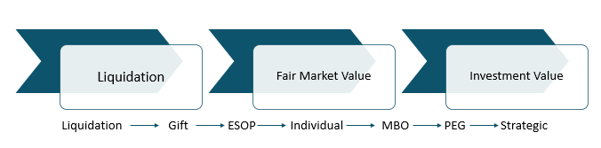
These buyer types correspond to a range of values—from liquidation value, to fair market value, to investment value. Strategic buyers often reside at the higher end of this spectrum but may require trade-offs in control, timing, and certainty. 1
Deal Structure Matters as Much as Price
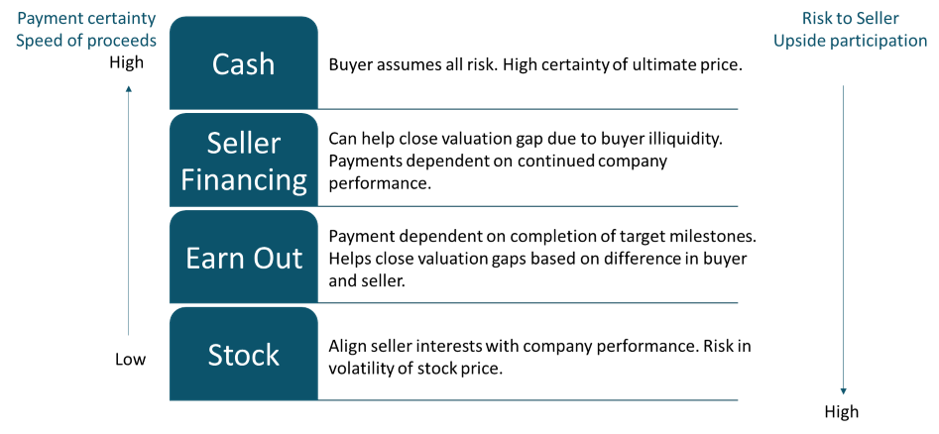
Two deals with the same headline price can yield very different outcomes depending on structure. Certain payment structures, such as an all cash deal, are high certainty and quick to receive proceeds, but leave no potential to participate in the upside or growth of the company post-transaction. On the other end, stock payments are often riskiest to the seller and the timing of benefits is unknown. Most deals include a hybrid of different payments and prove useful in bridging gaps in expectations between buyers and sellers.
Understanding these trade-offs is critical when evaluating offers and aligning them with personal risk tolerance and financial goals.
Setting Expectations Through Gap Analysis
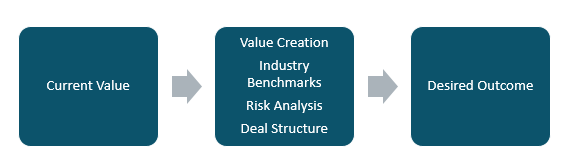
Once goals and buyer types are identified, the next step is a gap analysis:
- What is the business worth today?
- Where does the owner want to be at exit?
- What needs to change to bridge the gap?
A gap analysis will identify ways to create value and maximize optimal sale and exit outcomes. Additionally, comparing performance against industry benchmarks helps owners understand how their business stacks up relative to peers. Tracking these metrics over time allows owners to proactively improve positioning rather than reacting late in the process.
Valuation highlights key value drivers and risk factors, enabling owners to focus their efforts where they matter most.
Value Creation and the Story of the Business
At a high level, business value is driven by three interrelated factors: cash flow, growth, and risk. Addressing and improving these factors will be a positive factor in a sale, as buyers reward companies with strong cash flow, credible growth stories, and lower perceived risk.
Valuation is inherently forward-looking and is as much narrative as it is numerical. While methodologies such as discounted cash flow analyses, market multiples, and asset-based approaches provide structure, the story behind the numbers matters.
Buyers and investors want to understand:
- How the business generates sustainable earnings
- Why growth projections are achievable
- How risks are mitigated
Strong financial records, credible forecasting, and a compelling narrative together increase confidence and price.
Start Planning Before You Need To
Exit planning is not just about selling—it’s about running your business today as if you might sell tomorrow. By understanding value, aligning strategy with goals, and actively managing risk, business owners can expand their options, reduce stress, and increase the likelihood of a successful and rewarding transition.

Sara Maddox, ASA, ABV, CVA, EA
Sara Maddox is a Senior Manager and Director at DMJPS CPAs + Advisors in Business Valuations. At DMJPS, her work includes valuing business enterprises using fundamental and complex analysis for purposes of succession planning, gift and estate tax, mergers & acquisitions, litigation matters, and shareholder buyouts. She works with a variety of industries, including retail/wholesale, real estate and construction, professional and personal services, and manufacturing.